
Tutoring Franchise vs Retail Franchise: Which Shopfront Wins?
Both need a shopfront, but one sells products and the other sells memberships. Compare a tutoring franchise with a retail franchise on stock, staffing, hours, e-commerce risk and margins.

By Michael Black
Founder & Global CEO
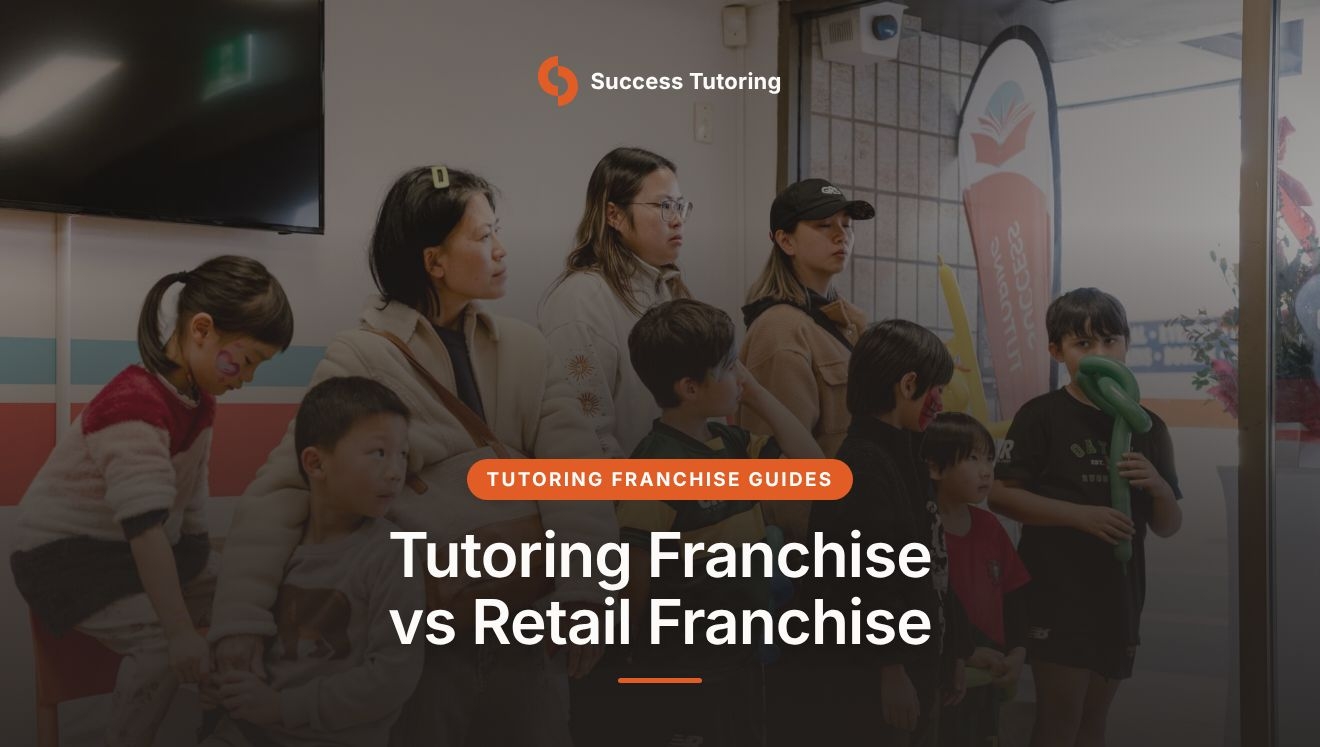
Walk through any suburban shopping strip and you will see retail franchises: phone repairs, pharmacies, post and print shops, homewares, health food, bottle shops. More and more, you will also see a tutoring centre among them. Both occupy the same kind of shopfront, rely on the same foot traffic and answer to the same landlord. So the tutoring franchise vs retail franchise comparison is a natural one for anyone who wants a visible local business.
The two models look alike from the footpath and behave very differently on the profit and loss statement. This guide compares them on investment, inventory, staffing, trading hours, exposure to online shopping, margin drivers and risk, using data from the US Census Bureau, the Australian Bureau of Statistics (ABS), the National Retail Federation (NRF) and franchise disclosure documents. Retail franchising has produced many successful owners; this is about matching the model to the owner.
Selling products versus selling progress
A retail franchise buys stock, displays it, and sells it at a margin. Every sale is a transaction, and the owner's job is to get the right products in front of enough customers at the right price.
A tutoring franchise sells a service on a membership. Families join, students attend weekly sessions, and revenue is the number of members multiplied by the membership price. The owner's job is to fill the centre and keep students progressing so families stay.
The practical result: a retailer manages stock and transactions; a tutoring owner manages people and relationships.
Tutoring franchise vs retail franchise: investment and fit-out
Retail franchise costs vary hugely by category. A small service-led format can be relatively modest; a pharmacy, liquor or large-format store can run into the millions once stock is included. As one widely known example, directory summaries of The UPS Store's recent FDDs put a traditional US centre at roughly US$209,000 to US$496,000, with non-traditional locations lower.
Retail start-up budgets must include opening inventory, point-of-sale systems, shelving and security, and those costs come back every time stock turns over. A tutoring centre's fit-out is classrooms, furniture, screens and branding; there is no opening stock. Directory summaries of 2024 and 2025 FDDs put major US tutoring brands at roughly US$74,000 to US$302,000. Read our guide to how much a tutoring franchise costs, and see the investment schedule for Success Tutoring's figures.
Inventory, shrink and working capital
Inventory is the defining feature of retail and the source of much of its risk.
- Cash tied up in stock. Money spent on stock sits on shelves until it sells. Slow-moving lines tie up working capital and may need discounting.
- Shrink. The NRF's 2023 National Retail Security Survey reported an average shrink rate of 1.6 per cent in fiscal 2022, equal to about US$112.1 billion in losses across US retail, with theft accounting for nearly two-thirds of it.
- Supplier pricing. Franchise retailers often buy through the franchisor's supply chain, which brings buying power but also limits the owner's ability to shop around.
A tutoring centre has none of this. It sells time and expertise, not boxes, so there is no stock to fund, count, discount or lose.
Online competition: the structural question
Every retail franchise now competes with e-commerce. The US Census Bureau reported that e-commerce reached about 17.1 per cent of seasonally adjusted US retail sales in the second quarter of 2026, up from 16.3 per cent a year earlier. In Australia, the ABS's final monthly Retail Trade release reported online sales at 12.7 per cent of total retail turnover in June 2025, and 19.0 per cent of non-food retail. Categories differ, and some retail formats have adapted well through click-and-collect and services, but the long-term shift is clear.
Tutoring faces online competition too, from platforms and online tutoring companies. The difference is that parents are not buying a commodity product that can be shipped more cheaply; they are buying an outcome for their child. IMARC Group's 2025 analysis of the global private tutoring market estimated offline tutoring held about 76.5 per cent of spending, partly reflecting parents' preference for face-to-face learning. Our article on online vs in-centre tutoring franchises explores that in detail.
Staffing and trading hours
Retail hours are set by customers and landlords. Shopping-centre tenancies often require trading seven days a week and late nights in peak seasons, and strip retail still needs weekend coverage. Rosters must cover every open hour regardless of how busy it is.
A tutoring centre's busy hours are weekday afternoons, early evenings and Saturday mornings, following the school day. Tutors work part-time shifts rostered against enrolments, so wage costs scale with members. Weekday mornings are for administration, parent calls and marketing.
Recurring revenue
Retail revenue is earned one transaction at a time. Loyalty programs help, but customers are free to buy elsewhere tomorrow, and revenue is exposed to seasonal peaks such as the end-of-year holidays.
Tutoring revenue is recurring. Families commit as members, so a centre starts each month with most of its revenue already known. Retention depends on results and relationships, which the centre can actively manage. See whether a tutoring franchise is profitable for how retention compounds.
Margin drivers compared
In retail, margin depends on gross margin on stock, stock turn, markdowns and shrink, rent on a high-traffic site, staff hours relative to sales, and royalties and supply-chain markups.
In tutoring, margin depends on members against centre capacity, tutor wages as a share of revenue, rent, royalties and marketing levies, and retention. There is no cost of goods and no stock-holding cost. Our potential earnings page explains how Success Tutoring models a centre.
Risks to weigh
Retail: online competition and price transparency; inventory risk, markdowns and shrink; long trading hours; reliance on foot traffic and the health of the shopping centre; and supplier concentration.
Tutoring: a ramp-up period while membership builds; seasonality; tutor recruitment and quality; and retention that depends on visible progress. Launch pre-marketing reduces ramp-up risk; Success Tutoring centres have reported opening with 45, 55, 60 and 70+ members on day one. See our launch support page.
Who each franchise suits
- A retail franchise suits owners who enjoy merchandising, buying and selling, are comfortable managing stock and cash flow, and can handle long trading hours. Categories with a strong service component or local necessity tend to be most resilient to online competition.
- A tutoring franchise suits owners who want a shopfront business without stock, prefer recurring memberships to one-off sales, want school-hours trading and enjoy working with families and schools. You do not need to be a teacher.
For the bigger picture, read our tutoring franchise guide and best franchises in the world for 2026, or compare tutoring with coffee franchises, cleaning franchises and food franchises.
Why a membership-based tutoring franchise appeals
Retail taught franchising the value of a recognisable shopfront in the right location. A modern tutoring centre keeps that advantage, a bright, visible, retail-style site near schools and shops, while replacing stock and transactions with memberships and learning outcomes. Success Tutoring supports partners with site selection and leasing, fit-out, a K–12 English and Maths curriculum, tutor training and ongoing marketing.
Frequently asked questions
Is a tutoring franchise a type of retail franchise?
It trades from a retail-style site, but it is a service business. There is no stock, revenue comes from memberships rather than product sales, and peak hours follow the school day.
Is a tutoring franchise safer from online competition than retail?
No business is immune, and online tutoring is a real competitor. But parents buy tutoring for an outcome and the evidence suggests most spending still goes to face-to-face tutoring, while many retail categories compete on price for identical products.
Which needs more working capital?
Retail usually does, because stock must be bought before it is sold and replenished continuously. A tutoring centre's main working-capital needs are rent and wages during the ramp-up period.
Can I convert a retail site into a tutoring centre?
Often, yes, subject to the lease, zoning and building rules. Retail tenancies near schools and family shopping are frequently ideal; talk to the franchisor's leasing team before signing anything.
Next steps
If you want a shopfront business without stock, built on recurring memberships, start with our Why us overview and follow the process to see available locations.
All third-party trademarks belong to their respective owners. Figures about other franchises are taken from their public websites, disclosure documents or reputable franchise directories at the time of writing and may have changed; verify them directly before making any decision. This article is general information, not financial or legal advice.

By Michael Black
Related Resources

Tutoring Franchise: The Complete Guide (2026)
Everything you need to know before buying a tutoring franchise in 2026: the global market, business models, costs, profitability drivers, regulation by country, how to choose a brand and the steps to open.

Tutoring Franchise in New Zealand: The Complete 2026 Guide
A practical guide to buying a tutoring franchise in New Zealand: NCEA pressure, the literacy and numeracy co-requisite, the FANZ code, the Fair Trading Act and what to look for in a brand.

Tutoring Franchise vs Childcare Franchise: An Honest Comparison
Childcare and tutoring both serve families, but the businesses are very different. Compare investment, staffing ratios, hours, regulation, subsidies and risk before you choose.