Former Kumon CEO Allan Menagh on Tutoring, Franchising and Why He Joined Success Tutoring
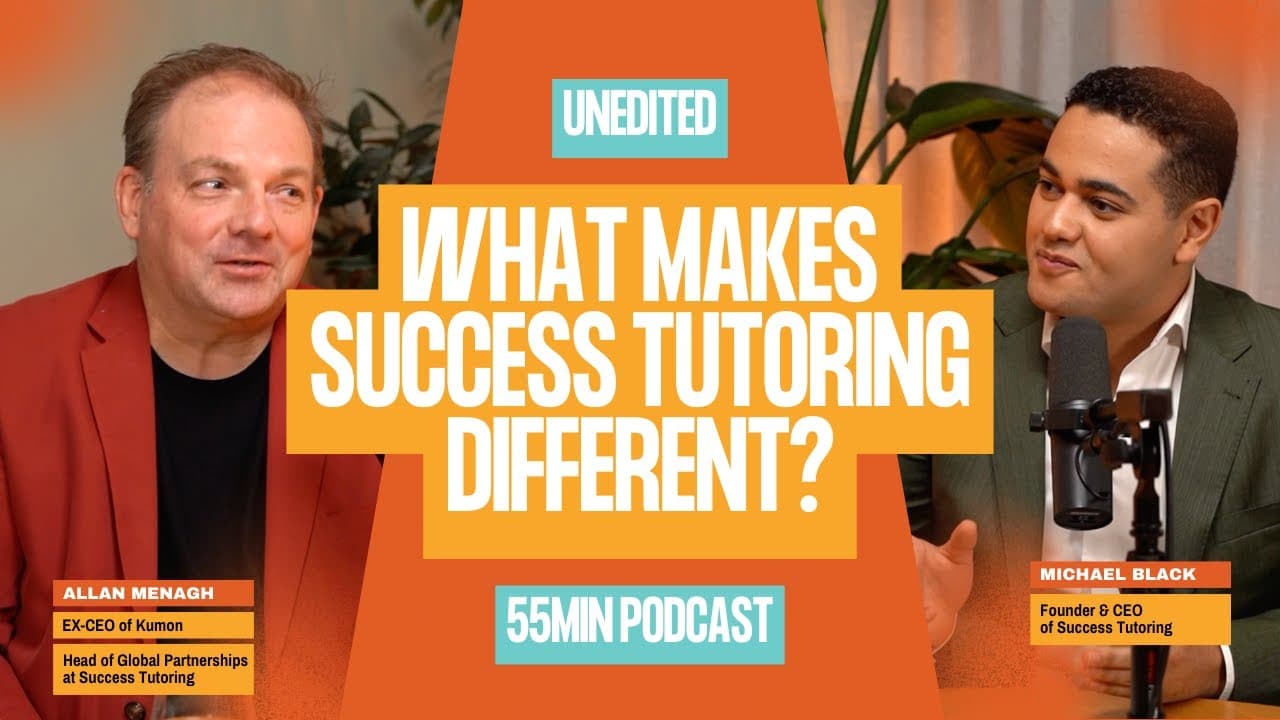
Allan Menagh, former CEO of Kumon in Australia and now Head of Global Partnerships at Success Tutoring, talks with founder Michael Black about what good tutoring looks like, what makes a franchise system work and why he joined.

By Michael Black
Founder & Global CEO
Few people have seen the tutoring franchise world from as many angles as Allan Menagh. He joined Kumon in his mid-20s as an area manager, ran centres himself when they were between franchisees, led operations in Western Australia, worked on communications nationally and across Asia, and eventually ran the organisation as CEO. Today he is Head of Global Partnerships at Success Tutoring. In this unedited podcast, he sits down with Success Tutoring founder Michael Black to talk about the state of education, what separates a good tutor from a knowledgeable one, how a membership model changes the relationship with families, and why he chose to join a younger, homegrown brand. It is aimed at anyone weighing up a tutoring franchise.

From area manager to CEO: Allan's path through Kumon
Allan describes himself as "a person that puts my hand up for projects", and that habit shaped his career. After starting in an entry-level area manager role, responsible for the growth, improvement and methodology compliance of a group of centres, he moved quickly to run the Western Australian operations for three years. Working largely on his own there, he says he "really had to connect with the work and represent the methodology".
He then created a national communications role in Sydney, and a conference built around in-depth student case studies went so well that the regional president for Asia invited him to do similar work across the region. Allan, who speaks Japanese, later returned to Australia with a brief to "reinject the method and energy" into the local network.
His views come from the franchisor side, the operations side and, at times, running a centre himself.
The education landscape: anxious parents and an uncertain future
Asked about the biggest challenges in education today, Allan points to two forces. The first has been building for years: parents' appetite for the best possible outcome for their children, paired with a feeling that no school fully satisfies it. As he puts it, "education and learning is a bit of a mysterious thing. So there's no guarantee." Students have to put in the work, and the real question is whether they know how to put in the work.
The second force is newer. Nobody can say with confidence which industries and skills will matter in 20 years, especially with AI and the shift to remote work and side hustles. Allan's answer is to go back to fundamentals: "to be useful you really need to have an ability to learn, you have to also have a belief in your own capacity to learn, you have to have good experiences about learning, and you have to be open to learning new things."
Michael adds that this is why he wants tutoring to teach students "not what to think but how to think", rather than relying on rote memorisation. Allan is quick to keep teachers on side, noting that personalising for 25 or 30 children is far harder than working one-on-one or with a small group. Tutoring, in his view, complements school.
What makes good tutoring: communication over content
One of the most practical parts of the conversation is Allan's view on what is missing from many tutoring programs. His answer is simple: "educators these days have to be really magnificent communicators."
Many people assume being brilliant at mathematics makes them a great tutor, but he says subject knowledge is not the deciding factor; common problems are not pausing and over-explaining. His advice:
- Keep explanations to around 30 seconds, then stop talking.
- Watch whether the student's eyes stay on the page while you speak.
- Ask the student to write down what they think the next step is, so you see exactly where understanding breaks down.
- Be patient, listen, say a little, wait for a response and "really draw a student out".
He frames all of this as customer service at the student level, which he calls "where the essence and the brilliance is". Michael agrees, describing a principle built into Success Tutoring's tutor training: build rapport first, and results come later.
Allan also talks about the vulnerable moment when a student has to reveal what they can and cannot do. "If they make you feel like a goose, it's all over," he says. Students need to know they won't be embarrassed in front of the tutor or their parents. Talking with parents needs the same sincerity: never exaggerate, and show you genuinely know their child.
What makes a tutoring franchise system work
Drawing on his years running Kumon operations in Australia, New Zealand and Singapore, Allan gives a balanced view of what worked well and what was hard. He credits Kumon's worksheet methodology for being transparent and individualised: parents can see clearly whether their child can do the work. The harder challenge, he says, is making the experience personal as well as individual. "You can individualise on data," he explains, but to make it personal the student has to feel "that you see them and you know them and you like them". Doing that consistently with large numbers of students is difficult.
He adds that where the franchisee is the instructor, excellence takes years of experience, and a student changing centres may find their program adjusted by a new instructor.
Michael explains that he designed Success Tutoring's personalised program to remove that discretion: a student who completes the assessment receives the same program regardless of which centre they attend, because he believes discretion leads to inconsistency. He also points out a structural difference: rather than franchise partners having to instruct every student themselves, Success Tutoring centres hire managers and tutors. Both agree there are strengths in each approach.
For prospective franchise partners, the takeaways are clear questions to ask any franchisor:
- How consistent is the program from one centre to the next?
- How much depends on the owner's personal teaching skill?
- How does the system train tutors in communication and rapport, not just content?
Why flexibility and community matter to families
Michael describes the change he made during COVID: turning Success Tutoring into a membership-based model, which he compares to a gym, with weekly payments, no lock-in contracts and an app that lets parents manage bookings.
Allan calls giving parents that flexibility "genius". He observes that some organisations lock families into a term, a quarter or a year paid in advance, and that withdrawing can take weeks and involve uncomfortable conversations about money. "These days people don't want to be locked into anything," he says.
The second aspect he values is harder to copy: a sense of belonging. He sees real value in building a membership mindset through every part of the operation, so students have a reason to keep coming back and make friends with peers and tutors.
Why Allan Menagh joined Success Tutoring
Allan was introduced to Michael by the CEO of the Australian Tutoring Association, someone he has known for more than 20 years, who told him the two "could do a lot together". On that first call, Allan says he found Michael grounded and sensible but deeply passionate, and he means a specific kind of passion: "passion as in suffering passion". In other words, the founder had done the hard work of building the business.
Over the following months, as Michael walked him through the technical side of the system, Allan says two things stood out. First, after years of consulting across education, he had seen many organisations build a model years ago and stop there. Success Tutoring, by contrast, had "a vision, you've created something around that vision, but you've got an aspiration" for where it was heading. Second, it was homegrown: started in Australia, drawn from Michael's own experience as a student, rather than imported from overseas.
He also mentions the calibre of people he has met on calls with prospective franchise partners. "I'm often amazed at the detail and insightfulness of their questions," he says, and he expects people who ask good questions to pay close attention to hiring, training follow-up and customer service once they are running a centre. He values that franchise partners are invited to contribute ideas, summing up the attitude as: "It's not perfect. It's good. It can be better, and let's head onwards and upwards."
Practical takeaways if you are considering a tutoring franchise
- Pick a category you genuinely care about. Allan suggests imagining being asked at a gathering what you have invested in. You want to be proud and keen to talk about it.
- Values come first. Michael says Success Tutoring looks for franchise partners who align with its values of Motivate, Uplift, Inspire and want to be in it for the long term, not simply people with capital. Partners do not need a teaching background, as tutor training and systems may be provided under the franchise agreement, but customer service instincts cannot be taught.
- Ownership structures vary. Michael notes that some partners operate their centre directly, while others hire a manager or partner with an experienced educator. Check what any structure would involve for you.
- Only proceed if it resonates. Allan's advice to viewers is direct: "if you've listened to all this and you're not interested, then it's not for you." If it does resonate, contact the franchisor and work through the concrete details.
Frequently asked questions
Who is Allan Menagh?
Allan Menagh is Head of Global Partnerships at Success Tutoring. He spent many years at Kumon, starting as an area manager and later leading operations in Western Australia, working on communications nationally and across Asia, and eventually running the organisation as CEO, with responsibility for Australia, New Zealand and Singapore at different times.
What does Allan Menagh think is missing from tutoring today?
He believes tutors need to be excellent communicators, not just subject experts. That means short explanations, careful observation, patience and building enough rapport that students feel safe showing what they don't understand.
Why did a former Kumon CEO join Success Tutoring?
Allan says he was drawn by Michael Black's grounded passion, the work already built into the system, an aspiration to keep improving rather than standing still, and the fact that the brand is homegrown in Australia.
Do I need a teaching background to run a tutoring franchise?
Not at Success Tutoring. Michael says the brand looks for customer service skills and values alignment, while systems and tutor training may be provided as set out in the franchise agreement and disclosure documents.
Learn more
If Allan and Michael's conversation resonated with you, start with why franchise partners choose Success Tutoring, then read about the process of becoming a franchise partner and review the investment schedule before you speak with our team. As with any franchise, read the disclosure documents carefully and seek independent legal and financial advice before making a decision.

By Michael Black
Related Resources

Why a Teacher Brought a Tutoring Franchise to New Zealand: Tom's Story at Success Tutoring Northwest
Tom, franchise partner of Success Tutoring Northwest, the first Success Tutoring centre in New Zealand, explains how teaching, legal and business experience led him to open a tutoring franchise.

From New Parent to First-Time Business Owner: A Tutoring Franchise Partner's Story
A Success Tutoring franchise partner shares why the birth of their first child, and years spent around education, led them to open their own tutoring centre with no prior business experience.

From Electrical Engineer to Success Tutoring Franchise Partner: Thomas's Story
Thomas spent more than 20 years as an electrical engineer and project manager. Now he runs a Success Tutoring centre in Brisbane alongside a part-time engineering role. Here is why he made the move and what his days look like.